Showing posts with label references. Show all posts

Design considerations: Scarecrow

I found that I had a far more difficult time drawing the scarecrow than the crow; I'm not entirely sure why. I think it's mostly due to the fact that I don't 'know' him very well — I've not really spent enough time with him. It's one thing to know a character's personality but another matter entirely to truly understand what makes them tick. But, again, this is mostly shape experimentation — once I've got a feel for the shape of scarecrows I can begin trying to get inside his head and really work on bringing some life into him.

Just to clarify, obviously what I'm putting here is simply my own interpretation of the characters — I hope I don't come across as if I've totally dominated the design! I just thought it might be helpful to put these up and show how I approached the subject. :]
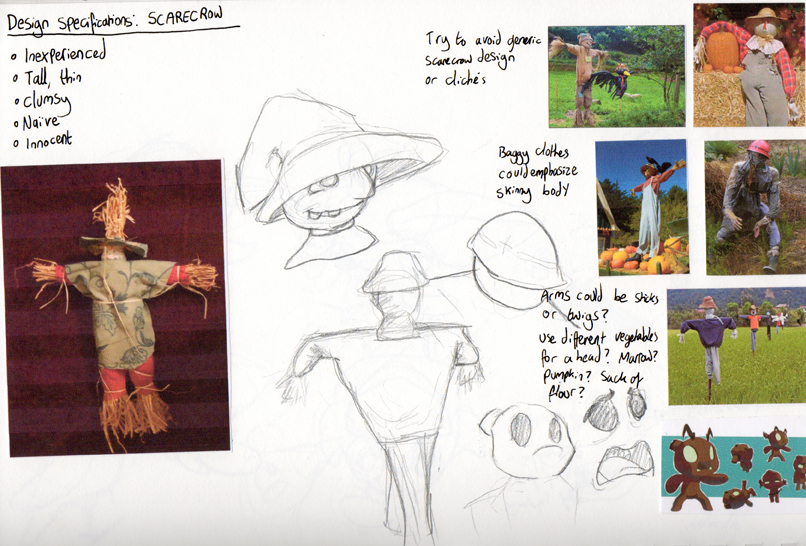


Again, I started just by looking very generally at some scarecrows. I really liked the one in the lower right corner; a great example of a simple but pretty refreshing take on the conventional scarecrow!


I toyed with the idea that maybe the scarecrow could look as if he was trying to be scary, perhaps by giving him long, thin and pointed fingers — perhaps they could even be made out of sticks?

Jazzy specified that the scarecrow should be tall and very thin to emphasize his clumsy nature — maybe we could give him big hands and feet to further suggest this? 

I was looking at some other tall, spindly characters as a point of reference —Jack Skellington in particular, as though he's a little different to what we're going for in terms of design his exaggeratedly thin limbs and a rather large, circular head are quite nice features for a scarecrow. I really liked how the eyes and mouth looked on Jack so I tried to incorporate something similar into some of the sketches.

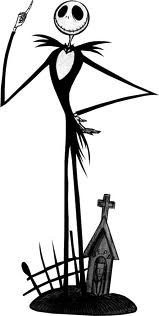

I was mostly just experimenting with body language and more head designs here; I wondered how a naive and slightly nervous character might hold himself, I thought perhaps with his feet turned inwards, but he just ended up looking really timid and anxious. 

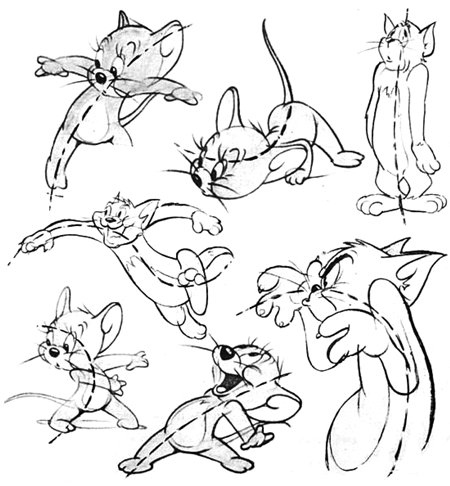
A stocky design for the crow might work quite nicely with a scrawny scarecrow — the combination of tall/thin and short/stocky characters is quite prevalent in a lot of children's animation. Many notable cartoon duos have massively contrasting body structures:

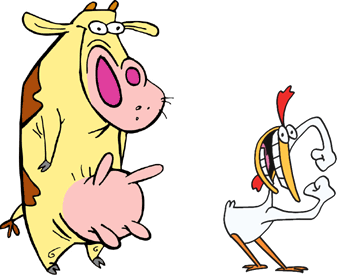


Radically different body structures in visual media where two or more main characters dominate the screen helps to create visual distinction and interest — strong silhouettes so that the characters remain recognisable in any given situation (at a distance, in the shadows, even in different costumes)

I thought this might be a nice idea to play around with and so experimented a little more with the idea of a short, fat crow:


I started trying to think more about character interaction at this stage — how the scarecrow might physically respond to the crow whenever it comes near him. Should it be outright terror, or is it more subtle? Is he merely uncomfortable around crows, or physically repulsed?

Was thinking about what sort of clothes he might wear and was slightly amused with the thought that, being a scarecrow, he just wore whatever leftover tat the owners had lying around — an outsized sweater, a lonely oven glove?

I'm going to focus more on actual scenarios and character interaction now, to try and really get to grips with the relationship and personalities of the two characters. Hopefully this will help me bring out more character in these drawings!

Design considerations: Crow

Well the pitch is over — let's not dwell on what did or didn't happen — I've been made producer as part of Group 7 with some most fabulous team mates, lead by our great director Jazzy. Our animation monkies executive animators are Sam (Bunce) and Jae (Hezhenyi). Very very pleased with this outcome and really excited to get started. If a bit nervous (what else is new?)

Jazzy's asked for us all to start sketching out some ideas in terms of character design and story progression, so that when time comes on Tuesday to begin scriptwriting we can cherry pick from everybody's work so that the final product is something that each of us feel we had a fair share of input on.

I've been scribbling both characters (the scarecrow and the crow), trying to come up with something interesting, and just figured I'd post up my progress (and the usual rambling reflection) so far.


The first stage in designing an interesting or strong character is, I feel, gaining an understanding of what it is that you're drawing. If your character is an anthropomorphic singing teapot, go and draw lots of teapots and start considering how you might anthropomorphise or physically characterise them! In this instance, the character's a crow, so I started on Google Images and started drawing a bunch of crows with varying success. Mostly none.

I had a great deal of difficulty in drawing the crows from reference. I can't simply sit down and copy what's in front of me — I find it very difficult to capture any sort of life that the original has if I don't understand why it's shaped like that or why it moves that way. As you can see from the drawings above I really wasn't into it — my crows looked more like seagulls!


So, for me, the next logical step was to take a look at some basic bird anatomy. I Googled a bunch of skeletons and a basic bird anatomy tutorial that explained the basic positions of limbs, construction of muscles etc. I don't feel there's a need to turn it into a biology lesson and learn the names of each underlying bone or muscle, but just knowing what's underneath the surface of what you're drawing — the construction and the basic mechanics — is amazingly helpful. 


As proof — look! My crows, I feel, improved noticeably almost instantly (except that one in the lower right corner — no idea what happened there). I'm certainly still no wildlife artist, but I feel that I understand where the legs were, the wings, why the back was that shape and why the head arcs like that. As a result the drawings came together much more easily. In cases where the subject is very dark in colour and you can't see a clear outline of the limbs, knowing that they're there and how they move allows you to make an informed estimation when drawing them. 

Enough self-centred bragging, on with the designs:


I now started considering how a crow's design might be simplified or caricatured. They have much larger beaks and very beady little eyes, so it made sense to try and exaggerate those features as part of the design. Jazzy said that the scarecrow should be tall and thin, so I thought it would be quite nice to have the crow short and stocky with a lot of rounded edges to create a bit of contrast. 


Still toying around with the short/round crow idea at this stage. I was playing around with constructing the body from different shapes to see how that would effect the silhouette and implied personality of the character. I think I was struggling a bit at this point — I find it tricky to portray the personality of a character without context. Static sketches like these always tend to be a bit lifeless and dull, but at this point I'm just trying to get a feel for how different shapes and bodies come across.


The other specification/suggestion Jazzy gave us for this crow is that she wanted it to be very subtly girlish, so that there was a kind of flirtatious implication between the two characters. Of course the first thought is always to just add eyelashes to it, but that tends to feel a bit shallow and too obvious. I messed around with the idea of adding rosy cheeks to it instead, which I thought might work quite nicely with the dark feathers?


More toying with body types. I'm really liking the idea of such a squat body with almost no limbs — I think it creates quite a nice silhouette and gives a lot of distinction to the character. 


I'm not terribly happy with the drawings I've done so far; they feel quite stiff and just generally lacking somewhere. I think that a lot of it is to do with context; as I said, I find it quite tricky to portray the character without it — I suppose these could just be seen as exercises to get going, to get a feel for shapes. I think the real character will start coming through and developing itself once we start building scenarios. 

Movement, Story & Structure: Animal costume research

I'm actually really quite liking the idea of dressing up/imitating animals to "attract" this girl, so I've been looking at some examples of animal behaviours/mating rituals. One of the more interesting ones is a bird that can moonwalk!

I think there's a lot of fun that could be had here — an endless amount of animals with bizarre or hilarious behaviours he could emulate.

Mr Stache

OK, this one's a bit sillier and it's not animation but it made me chuckle and it's quite a nice take on the theme of identity:


It was created from a very bizarre pitch received in a competition, in which a guy, staring deadpan into the camera, describes a "very serious drama about a guy who grows a mustache and everybody hates his mustache and he's sad because everyone hates his mustache." All's well, though, as our hero eventually finds acceptance in a girl… with a mustache.

It's totally silly but actually quite a refreshing look at the whole thing. Again, an example of a relatively simple concept executed with a bit more depth. It's quite dialogue-heavy, though that tends to be more for comedy value rather than story progression. I'd imagine you could tell a very similar story with no dialogue at all.

Café Bar

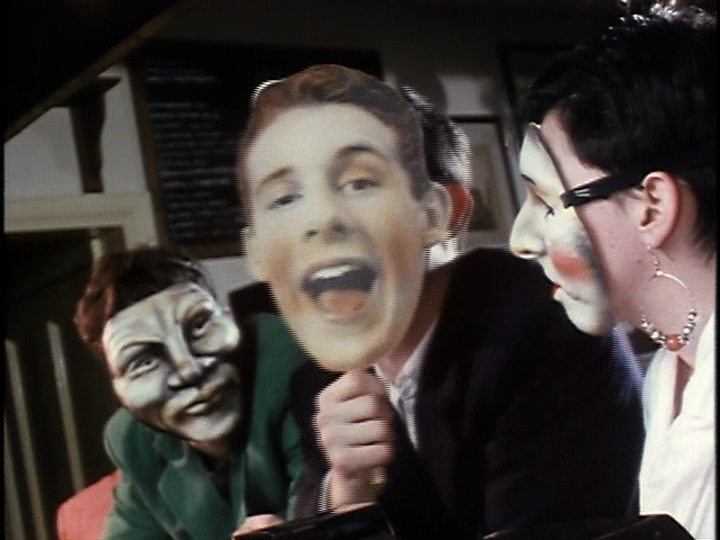
Another one from British Animation Classics — Café Bar by Alison de Vere.


I'm really liking the style — the inclusion of a mask is an added bonus — using colours to emphasise all the important or dreamlike segments, a ray of excitement in an otherwise bland existence, establishing false identities before finding acceptance in the mundane and regularity of everyday life.

The scene in the beginning where the man takes off his beard and glasses also got me questioning my use of masks and whether they have to be masks at all — could they not be props or costumes used to project a different identity? What if they weren't human masks? I think the biggest issue at the moment is that I'm trying to make a concept around a film rather than a film around a concept, causing me a bit of difficulty in actually progressing. It feels a bit like I'm creating symbols with nothing to actually symbolise. I think what I need is to take a few steps back and try to come up with a solid concept or theme. If I can summarise my intention — the message of the film — concisely in one sentence then it might be easier to start fitting the rest of the pieces into place.

'Oozat'

Had an absolutely terrible time of it this afternoon, I don't know if my brain was just fried or what but I just could not get anywhere. I couldn't seem to hold an image in my brain — I've got a real headache now. And snow blindness from staring at a blank page.

Managed to get my hands on a copy of 'Oozat' though — featured on the British Animation Classics Volume 2 DVD. I had to watch it a couple of times to really 'get it' — it's actually pretty straightforward but I think I tried to over-analyse it the first time, looking too hard for some kind of deep and hidden meaning. I'm always afraid of seeming stupid so I tend to try too hard to 'get' things rather than taking them at face value. Sorry, rambling again! Melty brain no work good.


Anywho, there's a really imaginative use of masks here. I found it interesting how they were used to show expression and identity rather than conceal it — something I'd never considered before!


I was fairly surprised how close it was to my original idea — having the confusion with constantly switching identities rapidly is perfectly captured here and it's kept very simple with only a few characters. I tend to think too much about the larger mechanics of things and sometimes find it difficult to boil it down, so this is a very useful reference. It shows that you really don't need to go overboard with detail — you can summarise potentially complex relationships very quickly with only a few characters. Certainly something to bear in mind.

It's not really related but there was another great short I came across on the DVD — Manipulated by Daniel Greaves (also ex-Farnham!)


It's an absolutely fantastic piece of animation. Demonstrating an animator just having a bit of fun, with an astounding result. I think I've seen something similar before but I don't remember what it was called or who made it (how helpful) but it involved the animator interacting with a rabbit-like character? Always loved these kinds of animation — pure body language and character oozing from every orifice.

'The Itch of the Golden Nit'

http://www.bbc.co.uk/news/uk-england-london-13298320

Interesting example of children's illustrations used in animation — this could be an interesting technique to use in contrast to some quite 'adult' phobias, such as debt, redundancy or getting old.

Phobias are often seen as something quite childish and even a sign of weakness — animating with contrastingly simplistic and childish drawings could represent the perceived innocence of fear, the idea that even the strongest and most authoritative of us are reduced to 'children' in the face of fear.

Sketchbook: Lines of action

Been having a little look into the basics of posing in the hopes of helping my stiff clean up situation. The crux of strong, energetic posing is all about weight and balance so I'm revising 'lines of action' —an initial line drawn to express the momentum of a pose and "describe the force moving through the body."  


I tried copying some of the illustrations on the examples to see if I could try to understand how the line placement corresponded to the body but I don't think it really got me very far. Copying somebody else's lines doesn't really help you to understand the subject. I wasn't feeling the weight of what I was drawing at all. I tried a few experiments of my own, using poses from www.posemaniacs.com (Great drawing tool if you're not already familiar with it!)


Posemaniacs is a great resource but unfortunately it's not the same as drawing from life. It's helpful to understand the body and anatomy a little better but a lot of the poses are quite stiff. Still, I think it would be a useful experiment to try and exaggerate some of the poses!

I think that a large part of my problem lies in relying on sketchy lines to help a pose feel powerful, rather than keeping the actual feel of the overall drawing energetic. Because my initial posing and lines are a bit weak, my clean ups tend to look static and uninteresting. A good pose should be identifiable "feel" the same, even when reduced to a silhouette. If I can begin to fully understand weight and balance and figure out how to better express that in my drawings I think I'll be on the right track.

Similar to what we did in life drawing I think I need to start committing myself to drawing using less lines. I need to be able to capture the feeling and weight of a pose in as few lines as possible, which should hopefully serve to give my initial drawings more strength.

Digital Animaton: Alice & Martin Provensen (textural/colour influence)

I've been looking a little more into Alice & Martin Provensen's work, discovering (to my delight) that that they did more than just bright, primary-coloured cutout work. I found a small selection of grittier images that use a much more toned-down palette which I think is much more in keeping with the fairytale theme I've been pursuing so far.
The cutouts as seen here are still very stylised and simplistic. The boy in the bed on the left, in particular, strikes me as very 'puppet-y'. It's very easy to imagine what he would look like in motion as an animated character.
The background elements are very softly coloured and almost always feature an outline. This is pretty interesting and something I hadn't initially noticed — not giving the characters an outline prevents them from merging into the background and becoming indecipherable. This is pretty well demonstrated in the image below:
The Provensens also did a lot of looser, sketchier work using very rough inks. Much like Arthur Rackham they seemed to use quite limited colour palettes, although I imagine this was a stylistic choice as opposed to technical necessity:
I love the gestural feeling of the drawings and all the textures. From the images above it looks like they may have used some sort of acrylic paint and watercolours with quite thick brushes. It seems as if they might have dabbed or stabbed as opposed to strokes with the brush. It almost has the feeling of a sponge painting.

I think it might be possible to replicate similar effects by almost carelessly overlapping paints. Clearly they weren't worried about staying inside the lines! I may experiment with loosely blocking out the general shapes with a colour wash (or even tea) in order to try and capture the instantaneous, gestural feel of the drawings.

Alice & Martin Provensen

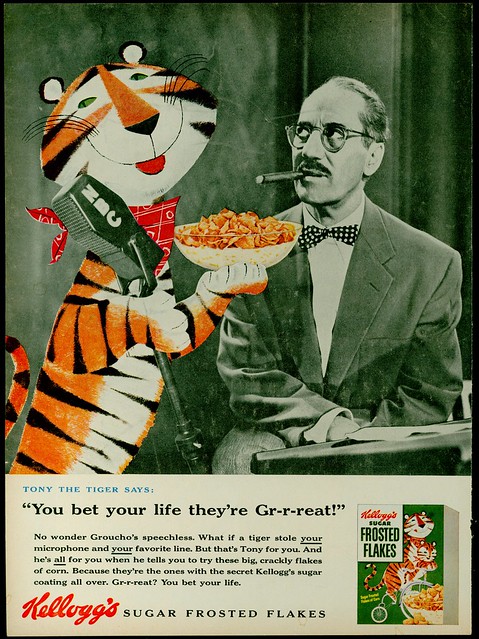
Found myself a bit of a dynamic duo whilst looking through one of the books I got from the library — Alice & Martin Provensen, a huband-wife team that illustrated children's books in the mid-'40s. Martin also designed Tony the tiger!

Image source

Image source

Image source
I love the contrast created between the detailed scenery and the colourful cutout characters. The bold and simplistic shapes against relatively detailed backdrops really brings the character into focus.

Digital Animation — partner notes

Just quickly adding the notes I took from my 'partner interview' (for want of a better term)

Craig Smitherman

21, Sittingbourne, currently living with brother in Guildford

Favourite place: Holland because of the scenery and night sky, stars
Most used phrases: "Hi," "You alright?" "How are you?"
Hobbies: Drawing, mostly people, listening to music.
Favourite music: Jazz, bluegrass, easy listening, country and folk. Melody Gardot, Dolly Parton, Alison Crowe

Has always wanted to visit Paris because of the architecture, sculpture and lifestyle. Would also like to go to Disneyland! Favourite time of day is night. Definitely more of an owl than a lark.

Interested in animation to tell stories. Has always drawn and written ideas, but never pieced them together. Previously attended UCA Canterbury

Interested mainly in 2D and stop motion animation — favourite film is Beauty & The Beast. Favourite animators are Glen Keane and Lotte Reiniger.

Favourite cartoons: Tom & Jerry, Loony Tunes, Spongebob

Favourite stories: The Night Before Christmas, Peter Pan. Loves children's stories and fairytales.

Favourite colour: Everything (mostly festive colours — red, gold, green).

Interested in Victorian era — dress style, decorative art. 

Who would play him in a film: Twin brother

Five words to describe himself: Funny, caring, polite, banter, creative

Would most like to see himself in a fairytale-type story