Showing posts with label research. Show all posts

Design considerations: Crow

Well the pitch is over — let's not dwell on what did or didn't happen — I've been made producer as part of Group 7 with some most fabulous team mates, lead by our great director Jazzy. Our animation monkies executive animators are Sam (Bunce) and Jae (Hezhenyi). Very very pleased with this outcome and really excited to get started. If a bit nervous (what else is new?)

Jazzy's asked for us all to start sketching out some ideas in terms of character design and story progression, so that when time comes on Tuesday to begin scriptwriting we can cherry pick from everybody's work so that the final product is something that each of us feel we had a fair share of input on.

I've been scribbling both characters (the scarecrow and the crow), trying to come up with something interesting, and just figured I'd post up my progress (and the usual rambling reflection) so far.


The first stage in designing an interesting or strong character is, I feel, gaining an understanding of what it is that you're drawing. If your character is an anthropomorphic singing teapot, go and draw lots of teapots and start considering how you might anthropomorphise or physically characterise them! In this instance, the character's a crow, so I started on Google Images and started drawing a bunch of crows with varying success. Mostly none.

I had a great deal of difficulty in drawing the crows from reference. I can't simply sit down and copy what's in front of me — I find it very difficult to capture any sort of life that the original has if I don't understand why it's shaped like that or why it moves that way. As you can see from the drawings above I really wasn't into it — my crows looked more like seagulls!


So, for me, the next logical step was to take a look at some basic bird anatomy. I Googled a bunch of skeletons and a basic bird anatomy tutorial that explained the basic positions of limbs, construction of muscles etc. I don't feel there's a need to turn it into a biology lesson and learn the names of each underlying bone or muscle, but just knowing what's underneath the surface of what you're drawing — the construction and the basic mechanics — is amazingly helpful. 


As proof — look! My crows, I feel, improved noticeably almost instantly (except that one in the lower right corner — no idea what happened there). I'm certainly still no wildlife artist, but I feel that I understand where the legs were, the wings, why the back was that shape and why the head arcs like that. As a result the drawings came together much more easily. In cases where the subject is very dark in colour and you can't see a clear outline of the limbs, knowing that they're there and how they move allows you to make an informed estimation when drawing them. 

Enough self-centred bragging, on with the designs:


I now started considering how a crow's design might be simplified or caricatured. They have much larger beaks and very beady little eyes, so it made sense to try and exaggerate those features as part of the design. Jazzy said that the scarecrow should be tall and thin, so I thought it would be quite nice to have the crow short and stocky with a lot of rounded edges to create a bit of contrast. 


Still toying around with the short/round crow idea at this stage. I was playing around with constructing the body from different shapes to see how that would effect the silhouette and implied personality of the character. I think I was struggling a bit at this point — I find it tricky to portray the personality of a character without context. Static sketches like these always tend to be a bit lifeless and dull, but at this point I'm just trying to get a feel for how different shapes and bodies come across.


The other specification/suggestion Jazzy gave us for this crow is that she wanted it to be very subtly girlish, so that there was a kind of flirtatious implication between the two characters. Of course the first thought is always to just add eyelashes to it, but that tends to feel a bit shallow and too obvious. I messed around with the idea of adding rosy cheeks to it instead, which I thought might work quite nicely with the dark feathers?


More toying with body types. I'm really liking the idea of such a squat body with almost no limbs — I think it creates quite a nice silhouette and gives a lot of distinction to the character. 


I'm not terribly happy with the drawings I've done so far; they feel quite stiff and just generally lacking somewhere. I think that a lot of it is to do with context; as I said, I find it quite tricky to portray the character without it — I suppose these could just be seen as exercises to get going, to get a feel for shapes. I think the real character will start coming through and developing itself once we start building scenarios. 

'Oozat'

Had an absolutely terrible time of it this afternoon, I don't know if my brain was just fried or what but I just could not get anywhere. I couldn't seem to hold an image in my brain — I've got a real headache now. And snow blindness from staring at a blank page.

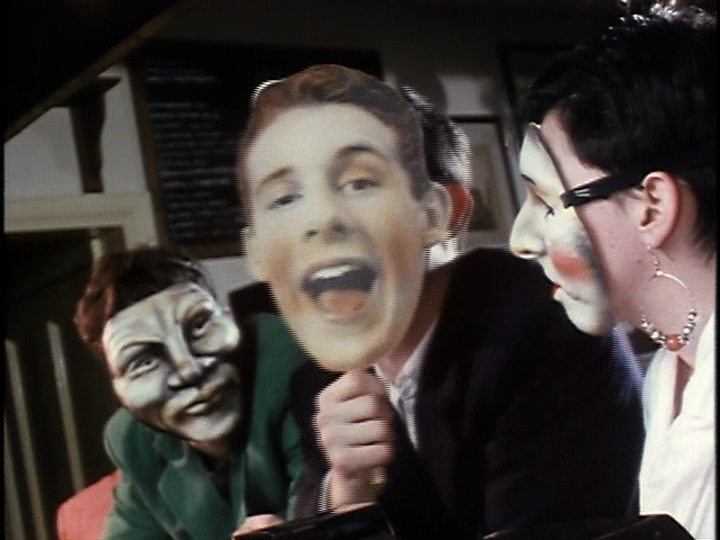
Managed to get my hands on a copy of 'Oozat' though — featured on the British Animation Classics Volume 2 DVD. I had to watch it a couple of times to really 'get it' — it's actually pretty straightforward but I think I tried to over-analyse it the first time, looking too hard for some kind of deep and hidden meaning. I'm always afraid of seeming stupid so I tend to try too hard to 'get' things rather than taking them at face value. Sorry, rambling again! Melty brain no work good.


Anywho, there's a really imaginative use of masks here. I found it interesting how they were used to show expression and identity rather than conceal it — something I'd never considered before!


I was fairly surprised how close it was to my original idea — having the confusion with constantly switching identities rapidly is perfectly captured here and it's kept very simple with only a few characters. I tend to think too much about the larger mechanics of things and sometimes find it difficult to boil it down, so this is a very useful reference. It shows that you really don't need to go overboard with detail — you can summarise potentially complex relationships very quickly with only a few characters. Certainly something to bear in mind.

It's not really related but there was another great short I came across on the DVD — Manipulated by Daniel Greaves (also ex-Farnham!)


It's an absolutely fantastic piece of animation. Demonstrating an animator just having a bit of fun, with an astounding result. I think I've seen something similar before but I don't remember what it was called or who made it (how helpful) but it involved the animator interacting with a rabbit-like character? Always loved these kinds of animation — pure body language and character oozing from every orifice.

Factual research: Arthur Rackham

Arthur Rackham, the 4th of 12 children, was born in London on 19 September 1867. From 1879 he attended the City of London school. Popular amongst his peers and teachers, Arthur was otherwise academically unremarkable — he demonstrated something of a talent for drawing and won a number of prizes from Herbett Dicksee, the school drawing master.

During 1884 Arthur spent 4 months in Australia where he became inspired by his surroundings, producing many watercolour paintings and sketches of the landscapes. Upon returning to England, he enrolled at the Lambeth School of Art as an evening student. He sought work during the day to help fund his education and in 1885 began a job clerking at the Westminster Fire Office.

Fig A: 'A Fact,' Scraps Magazine, 1884
During his time at the office, Rackham continued to produce many drawings and watercolours, one of which was publicly exhibited in 1888 at the Royal Academe. He frequently contributed drawings to local magazines and newspapers, the first of which was published in Scraps magazine in 1884 (Fig A). Though this (admittedly rather crude) drawing lacked anything of the charm for which Rackham's later illustrations would become renowned, he was already beginning to demonstrate a keen eye for line and form.

Fig B: 'How a Bank was Robbed,' Westminster Budget, 1893
Fig C: 'The Dolly Dialogues,' 1894
Through Rackham's regular contributions to local magazines, he was able leave the fire office in 1892 after securing a position as graphic journalist for the Westminster Budget. Rackham provided many illustrations for articles and ran a frequent column in which he would caricature public figures. The demand for photorealistic and 'straight line' technical drawings was high, given the nature of the position, but Rackham was granted opportunities to deviate and work in a far looser, more whimsical manner for which he would later become renowned.

Rackham received a large number of commercial commissions during the last decade of the century, with many drawings published in travel brochures, newspapers and even several books — including an illustrated edition of The Dolly Dialogues (a feature previously run in the Westminster Gazette) in 1894.

Aside from his distaste of the field in general (he found the paper's deadlines too constraining for the sort of meticulous detail his work often demanded), Rackham's eventual departure from journalism was forced by means of practical necessity. The role of the artist in journalism was threatened to become obsolete with the impending introduction of the camera.

He hit the height of his fame at the turn of the new century — shortly following his marriage to fellow artist Edyth Starkie in 1903, 99 of his illustrations were published in Fairy Tales of the Brothers Grimm to great success. The final revised edition, published in 1909, contained an astonishing 40 coloured illustrations and 55 line drawings. By the time of his death in 1939, Rackham had illustrated more than 60 children's books, including Peter Pan in Kensington Gardens, Alice's Adventures in Wonderland, Aesop's Fables, The Night Before Christmas, Cinderella and American classic Rip van Winkle. Rackham's final book, the Wind in the Willows, was published posthumously in 1940.

Sources:

Gettings, F., 1975. Arthur Rackham. London: Macmillan.
Hudson, D., 1960. Arthur Rackham: His Life and Work. 2nd ed. London: William Heinemann Ltd.
Arthur Rackham. 2011. Arthur Rackham. [ONLINE] Available at: http://www.bpib.com/illustrat/rackham.htm. [Accessed 25 September 2011].
Arthur Rackham Biography. 2011. Arthur Rackham Biography. [ONLINE] Available at: http://www.fairyworx.net/Arthur_Rackham.html. [Accessed 25 September 2011].

Reflecting on research methods

I've noticed, especially these past couple of days, that my research work is becoming more and more of a struggle. I seem to be scouring books and websites for hours on end without really coming back with anything to show for it, and I think it's because I'm unfocused. I'm worrying too much about what I think I should be reading or writing down. Rather than working as I normally would I'm very aware of the fact that people will be looking at it and constantly asking myself if it's what they want to see, or if it's "right." It is, of course, hugely important to consider things like assessment criteria and presentation, but it's getting to the point where I'm too afraid to write anything down in case it's "wrong" — which is totally counterproductive!

I've decided to try and re-evaluate the way I carry out my research and development work by creating a basic research template for myself and highlighting key bits of information I should be looking for. It's easy to get lost in a sea of sources when you don't really know what it is you're supposed to be looking for — worrying which bits I should and shouldn't be looking at, wondering whether this is important or that's important — but by reminding myself of exactly what I need to pick out, I should be able to carry out research much more efficiently.

What I really need to know is —

who I'm looking at
what they did
why and how they did it

What key dates are there in the artist's history? What years were they active? What are their notable publications?  What exhibitions have they been in?

It all sounds tremendously obvious and probably just fundamental skills I should know already, but I often find myself feeling very overwhelmed by the amount of information available. A lot of it is often influenced by the author's own opinions so it can sometimes be difficult to pick out the important and factual information. A lot of things are simply made to sound important because they've moved the author in some way, meaning I tend to 'not get it' and worry that maybe I've missed something.

I'm not intending to imply that opinions should always be disregarded — they are of course extremely valuable — but in cases like this I think it's better to initially start off as cleanly as possible so that you can better evaluate an artist on your own terms.